Organizational Transformation
Part II: From Integration to Impact — Building Organizational Capability
This is Part II of a multi-part series on Collaborative Intelligence and sustainable organizational transformation.
In Part I, we explored why sustainable transformation depends on more than technology alone. Organizations create lasting change when people, processes, leadership, and technology are connected through Collaborative Intelligence. But understanding the need for integration is only the beginning. The next question is how organizations turn that integration into organizational capability and measurable impact.
Ventrium's Human Intelligence Infrastructure Framework™ (HIIF™) establishes a methodology for catalyzing integration into impact. Without integration, new tools create friction rather than value. With it, organizations move beyond simple project implementation to build a continuous, culturally agile capacity for adaptation and long-term impact.
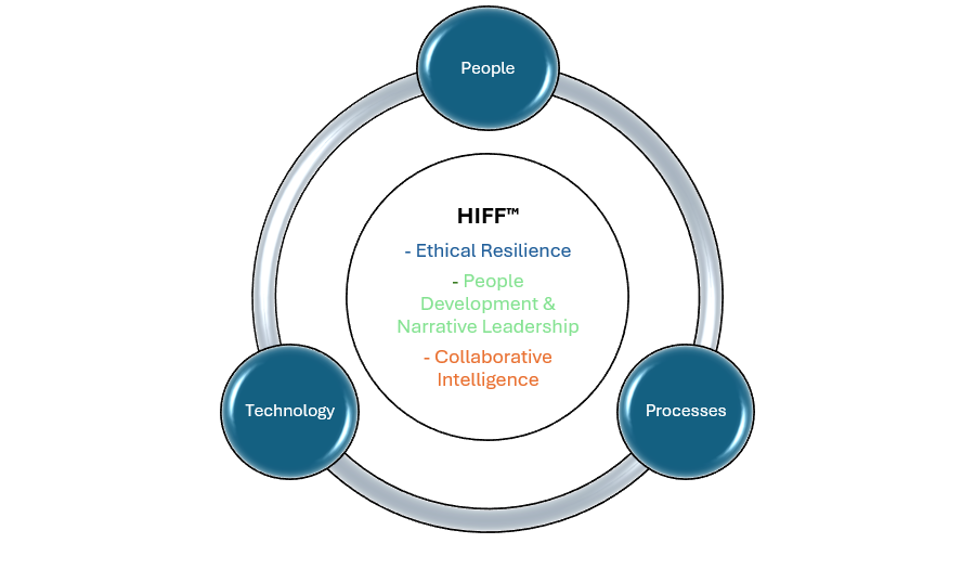
Three Strategic Capacities of HIIF™: Ethical Resilience, Narrative Leadership, and Collaborative Intelligence.
This second part moves from the principle of integration to the organizational foundations that make it possible: technology, operational processes and organizational design, leadership and decision-making, and workforce capability. Together, these areas determine whether transformation can move beyond implementation and become embedded in how an organization operates, adapts, and creates value.
1.Technology: Enabling Possibility, Not Defining Transformation
Technology remains an important driver of organizational change. Artificial intelligence, automation, enterprise platforms, analytics, and digital tools can improve efficiency, generate insights, and create new opportunities. However, technology creates value only when it supports the way people and organizations actually work. The question is not simply, "What can this technology do?" but rather, "How does this technology enable our people, processes, and strategy to achieve better outcomes?"
Technology should strengthen decision-making, simplify workflows, and support collaboration across the organization. When technology is introduced without connection to organizational priorities and everyday work, it can become another disconnected initiative competing for attention.
2.Operational Processes and Organizational Design: Creating Structures That Enable Collaboration
Transformation is not only about introducing new tools. It is also about examining how work moves through the organization. Many organizations attempt to modernize by adding new systems while maintaining outdated processes, unclear responsibilities, and structures that reinforce silos. New technology may change what is possible, but if the underlying organization continues to operate in old ways, the potential value of that technology remains limited.
Sustainable transformation requires organizations to rethink how decisions are made, how teams collaborate, how responsibilities are distributed, how information flows across functions, and how work is designed to support changing priorities. Organizational redesign should not simply create new structures. It should create better ways of working. When processes and organizational design evolve together, organizations become more agile, responsive, and capable of adapting to future challenges. More importantly, employees can see how new ways of working connect to the realities of their roles and responsibilities.
3.Leadership and Decision-Making: Creating Alignment Through Change
Transformation requires leaders who can create clarity during uncertainty. Leaders must do more than communicate change. They must build understanding, align priorities, encourage collaboration, and create the conditions for teams to succeed. When leaders are not aligned, transformation initiatives can quickly become fragmented.
For example, different departments may pursue different goals, teams may interpret priorities differently, and organizations may invest significant resources while moving in different directions. Collaborative Intelligence strengthens leadership by connecting strategy with execution. It enables leaders to create shared understanding, coordinate action across boundaries, and guide organizations through complexity.
Leadership alignment also helps employees understand not only what is changing, but why it matters and how their work contributes to the broader organizational direction.
4.Workforce Modernization and People Capability: Preparing People for the Future of Work
Organizations cannot transform without developing the people who make transformation possible. Workforce modernization extends beyond technical training or learning how to use new tools. It involves developing the capabilities required to operate effectively in changing environments, including adaptability, critical thinking, collaboration, communication, problem-solving, continuous learning, and leadership capability.
Employees and leaders need more than just instructions on how to use new systems. They need the confidence, mindset, and skills to navigate uncertainty, make informed decisions, collaborate across boundaries, and contribute to new ways of working. When workforce capability evolves alongside technology, leadership, and organizational design, transformation becomes more sustainable. People are not simply asked to adapt to change; they are equipped to participate in shaping and sustaining it.
Human Intelligence Infrastructure Framework™: The Foundation for Sustainable Transformation
At Ventrium, we believe organizations should not approach transformation as a collection of separate initiatives. Digital transformation, organizational redesign, workforce modernization, and change management are interconnected challenges that require a unified approach. This is why Ventrium developed the Human Intelligence Infrastructure Framework™ (HIIF™).
HIIF™ provides a comprehensive strategy for helping organizations align people, processes, technology, leadership, and organizational capability into one integrated system. The framework recognizes that technology alone cannot create transformation. Organizations need the human infrastructure required to make change meaningful, sustainable, and scalable.
The three HIIF™ pillars create a broader foundation for sustainable transformation:
Ethical Resilience
Maintaining a moral compass through fairness, transparency, and responsible decision-making — even under pressure, uncertainty, budget constraints, or competing stakeholder demands.
People Development & Narrative Leadership
Equipping leaders and teams with the skills, mindset, and adaptability required to respond effectively to new challenges while creating shared understanding around change.
Collaborative Intelligence
Building the cultural agility required for organizations to integrate change, strengthen collaboration, and adapt continuously.
From Managing Change to Building Organizational Capability
Many organizations still approach transformation as a collection of separate projects: a technology implementation, a restructuring initiative, a workforce development program, or a change management effort. Sustainable transformation requires organizations to move beyond managing individual projects and build the capabilities that allow the organization to continuously adapt.
This is the purpose of the HIIF™. It brings together people, processes, technology, leadership, and organizational capability into one integrated approach. The result is an organization that is better prepared to navigate uncertainty, respond to opportunities, and sustain performance through continuous change. Transformation becomes more than a project. It becomes an organizational capability.
Looking Ahead
Recognizing that technology must align with organizational reality is only the beginning. The next challenge is understanding how organizations can ensure that new systems, processes, and ways of working actually support the realities of everyday operations.
In our next article, we will explore Aligning New Systems with Real-World Operational Workflows. We will examine why successful transformation depends not only on implementing new technologies, but also on understanding how people collaborate, make decisions, and create value every day. Organizations should not have to reshape themselves simply to fit technology. Technology should support how organizations achieve their mission.
A Question for Every Organization
Whether an organization is pursuing digital transformation, organizational redesign, workforce modernization, or broader enterprise change, one question remains:
Are we managing separate transformation initiatives, or are we building the capabilities needed to align people, processes, and technology?
The answer will determine whether transformation becomes a collection of disconnected projects — or a lasting organizational capability.
Ready to build organizational capability?
Let's explore how the HIIF™ framework can help your organization move from managing change to building lasting adaptive capacity.